Digital Wardrobe App: From Clothing Photos to Agent Decisions
A useful digital wardrobe is not a photo archive. It turns clothes you own into editable context, then lets one clear request become an outfit, search, capsule, trip, or analysis action you can review.
Quick answer: a digital wardrobe becomes useful when it connects three layers: a clothing photo, an editable garment record, and a decision made from your real closet. In SELION.AI, the Agent can use saved wardrobe details and available personal or situational context to select a compatible action. You still review uncertain item details, the proposed action, and the real-world result.
What Makes a Digital Wardrobe Useful?
A digital wardrobe app creates a structured view of clothes you own. A basic catalog helps you remember what is in the closet. A decision-ready wardrobe also keeps the details that affect what you can wear and makes them available when you ask for help.
If your immediate job is organizing a personal catalog rather than comparing the broader workflow, use the clothing inventory app guide. It separates personal wardrobe records from retail stock software and shows how saved item details become Agent context.
For the current SELION product surface rather than a category comparison, inspect the digital closet organizer workflow. It shows how a saved wardrobe connects to reviewable actions without treating the catalog as the final outcome.
The difference matters because a folder of clothing photos cannot answer a constrained question by itself. To help with a decision, the system needs reviewable information such as what the item is, its color, material, pattern, season, warmth, formality, and fit. The useful outcome is not more catalog administration. It is less repeated setup when you want to act.
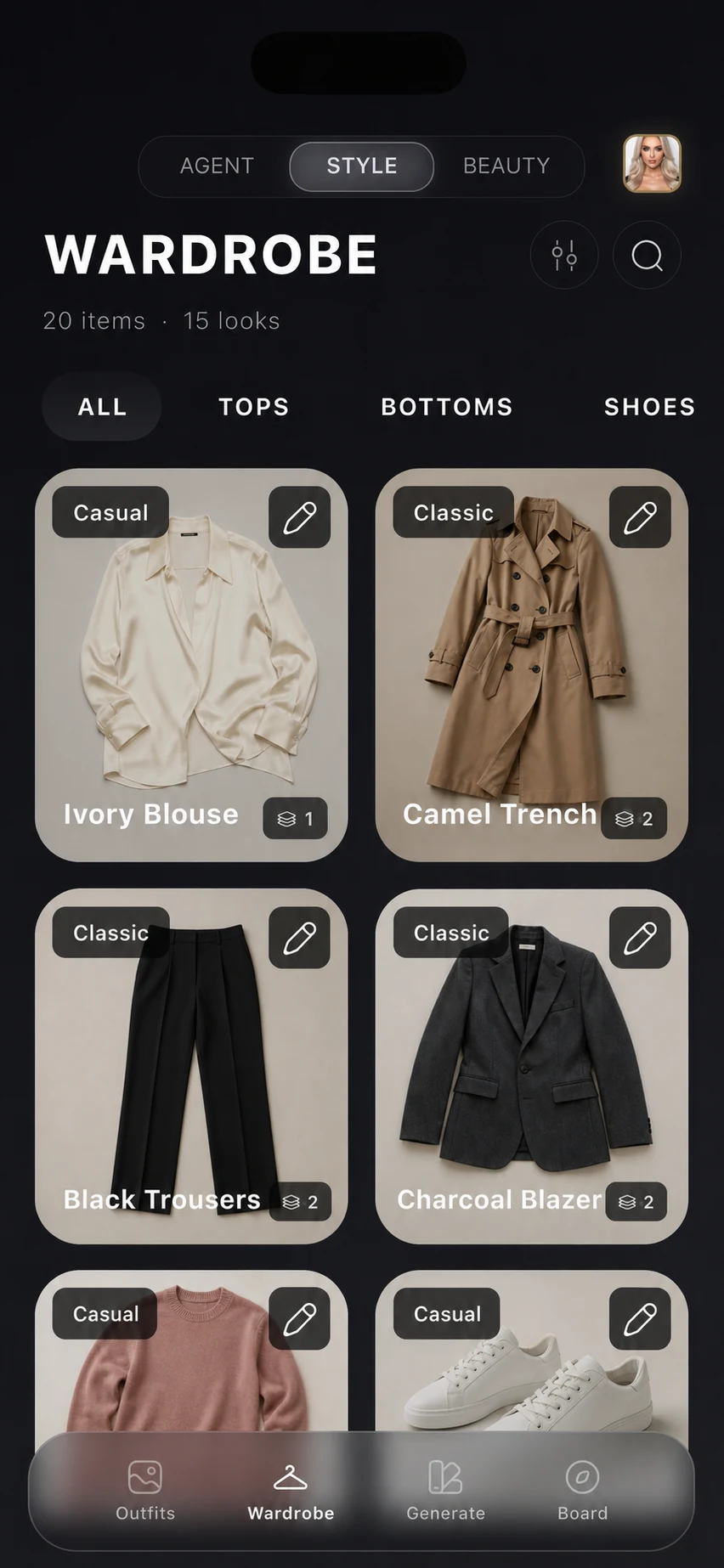
A decision-ready digital wardrobe can support several distinct jobs:
- Retrieval: find an item by saved attributes or location.
- Outfit decisions: ask for combinations grounded in clothes you own.
- Planning: reuse the same wardrobe for a capsule, trip, or future occasion.
- Analysis: review the wardrobe through the details that have actually been saved.
- Visual exploration: continue to a compatible generated idea or Virtual Try-On when available.
The Photo-to-Agent Workflow
The practical SELION.AI flow is deliberately reviewable. Recognition reduces repetitive entry, but it does not turn an uncertain photo into unquestionable truth.
- Photograph one item. Use a clear image with the main garment visible. The detailed clothing-photo guide explains the capture flow and common recognition limits.
- Review the proposed record. SELION.AI can propose category, color, material, pattern, season, warmth, formality, fit, and related attributes. Correct anything that does not match the real garment.
- Save the useful context. The item becomes part of the digital wardrobe instead of remaining an isolated image.
- Make one Agent request. State the outcome and constraints in normal language rather than opening a sequence of disconnected tools.
- Review the selected action. Depending on the request and current availability, the Agent can connect the wardrobe to search, outfit generation, analysis, Virtual Try-On, or capsule and trip planning.
For eligible actions, the product may ask for confirmation or continue according to the selected mode and action. Not every action uses the same confirmation flow. The important boundary is that the clothing record remains editable and the user can inspect the result.
What Can SELION Agent Use?
When information is present, SELION Agent can work with wardrobe, preference, weather, and situational context. That lets one request carry more of the decision than a generic image prompt.
| Context | What it can clarify | What still needs review |
|---|---|---|
| Saved garment details | Category, color, material, pattern, season, warmth, formality, fit, and related attributes | Whether the photo-derived details match the physical item |
| Wardrobe inventory | Which saved items are available as candidates | Cleanliness, damage, current location, and whether an item is actually available today |
| Preferences and prior feedback | Repeated style boundaries or choices when available | Whether the preference still applies to this occasion |
| Weather and situation | Conditions, occasion, destination, or other supplied constraints | Forecast changes, venue rules, and real comfort |
This is why the Agent is the decision layer rather than another catalog tab. The wardrobe provides owned-item context; the request provides today’s goal; the selected action turns both into something usable.
A Realistic Wardrobe Request
Suppose the wardrobe already contains a navy blazer, two shirts, dark jeans, tailored trousers, sneakers, and loafers. A generic request—“make me stylish”—leaves the important constraints unstated.
A decision-ready request is more specific:
Use clothes in my wardrobe for a business-casual dinner. I will walk outside in cool weather, I want flat shoes, and I would like two options with a removable layer.
The Agent can use the saved wardrobe and available context to choose a compatible next action. If the request leads to outfit generation, the result should be reviewed against the actual items. If the goal is a longer plan, the same wardrobe can continue into a capsule audit or trip workflow without rebuilding the clothing list.
That continuity is the practical benefit: the person describes the decision once, while the digital wardrobe supplies the reusable clothing context.
How to Evaluate a Digital Wardrobe App
Test with a small, representative set before cataloging the entire closet. Use one top, one bottom, one layer, one shoe, and one item that is visually difficult to classify.
1. Capture
Can you add a real garment from a photo without completing a long form first?
Continue from organization to the SELION AI wardrobe workflow, where reviewed garment details become reusable Agent context.
2. Correction
Can you edit important attributes when recognition or source data is wrong?
3. Retrieval
Can the app find and reuse the saved item in a later decision?
4. Action
Can one request lead to a useful outfit, search, analysis, capsule, trip, or visual step?
Also check the current official storefront, privacy policy, deletion route, support information, subscription terms, and platform availability. Mutable product and pricing details should come from current official sources, not an undated comparison.
What a Digital Wardrobe Cannot Verify
A clothing photo cannot prove physical fit, comfort, cleanliness, damage, transparency, texture, or how a fabric behaves in motion. Saved attributes can be incomplete. Weather can change. A workplace or venue can interpret a dress code differently.
Use the digital wardrobe and Agent to reduce the option set and connect tools. Then check the real garment, your body, the conditions, and any formal or safety requirement before wearing the result. Virtual Try-On is a generated visual preview, not a physical fit guarantee.
Try the Digital Wardrobe-to-Agent Workflow
Add a small set of real garments, correct the attributes that matter, and ask SELION Agent for one useful action grounded in your wardrobe.
View official download optionsFrequently Asked Questions
What is a digital wardrobe app?
A digital wardrobe app creates an editable catalog of clothes you own and makes that catalog useful for search, outfit decisions, and planning. The useful test is whether it can move from a real garment to a reviewable action, not simply store photos.
How does a clothing photo become a useful wardrobe item?
SELION.AI can propose editable details such as category, color, material, pattern, season, warmth, formality, and fit from a clothing photo. The user reviews and corrects those details before relying on them as wardrobe context.
How does SELION Agent use clothes I already own?
SELION Agent can use saved wardrobe details together with the user's request and available preference, weather, and situational context. It can select a compatible action such as wardrobe search, outfit generation, analysis, Virtual Try-On, or capsule and trip planning.
Can a digital wardrobe make every clothing decision automatically?
No. A digital wardrobe can narrow options and connect saved clothing to useful actions, but photos and saved attributes cannot confirm physical fit, comfort, garment condition, cleanliness, or dress-code acceptance. The user reviews the real clothes and the result.