Autonomous AI Fashion Agent: From Request to Wardrobe Action
The useful difference is not more chat. It is an Agent that can understand wardrobe context, choose an eligible tool, and keep the result reviewable.
Quick answer: an autonomous AI fashion agent connects a natural-language request with wardrobe context and a concrete action. Instead of returning only generic advice, it can propose a next step such as creating an outfit, preparing a plan, or starting a visual workflow. The user still reviews important inputs and results.
What “autonomous fashion agent” means
A chatbot answers. A generator produces one kind of output. An Agent can decide which available capability best fits the request, carry relevant context into that action, and return a result that can be revised. This is useful when the person knows the outcome they want but does not want to navigate a collection of separate tools.
Agent vs chatbot, generator, and closet grid
Closet grid
Organizes items you saved. It supplies the owned-clothes context but does not decide the next action.
To move from the concept to the current product flow, use SELION Agent with wardrobe context and reviewable actions.
Chatbot
Can discuss an outfit problem, but may remain generic if it cannot connect the answer to wardrobe data or product actions.
Outfit generator
Creates combinations. It solves one task well but does not necessarily orchestrate planning, analysis, or try-on.
Fashion Agent
Interprets the request, uses available context, and selects an eligible action while keeping key decisions visible.
Context an Agent can use
Useful context can include editable garment records, explicit preferences, the occasion, available weather information, recent corrections, and the exact constraint in the current request. A clothing photo can contribute proposed attributes such as category, color, material, pattern, season, warmth, formality, and fit; uncertain fields should remain correctable.
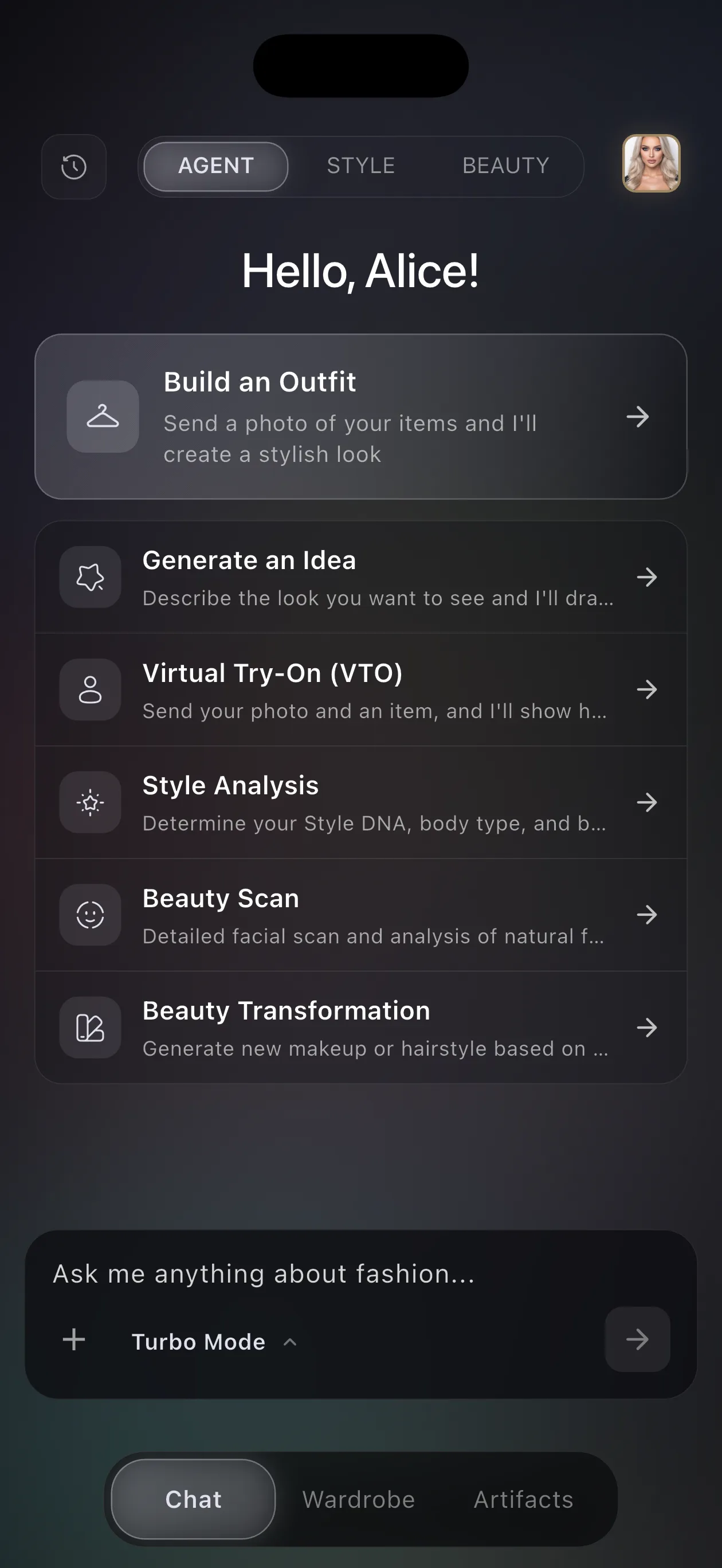
From one request to a reviewable action
- You describe the outcome: “Build a business-casual outfit for rain using clothes I own.”
- The Agent interprets the occasion and constraints.
- It uses relevant saved wardrobe context and identifies an eligible action.
- The app can present that action for approval or continue through an available automated flow.
- You inspect the garments, suitability, fit, comfort, and final result.
The low-effort part is orchestration: you state the goal once instead of manually transferring the same context between wardrobe, generation, planning, and visual tools.
User-controlled and more automated flows
SELION Agent supports a review-oriented Default Mode and a more automated Turbo Mode for eligible actions. Automation should not hide uncertainty or irreversible choices. The selected action, inputs, generation use, and result should remain understandable enough to approve, reject, or revise.
Three realistic Agent requests
- Daily decision: “Choose a polished outfit for today, but keep the shoes walkable.”
- Trip planning: “Use my wardrobe to prepare looks for three days with one evening dinner.”
- Outfit revision: “Keep this jacket and shoes, then make the rest less formal.”
How to evaluate an AI fashion agent
- Can it use clothes you actually saved rather than generic catalog items?
- Can you correct garment attributes before they become styling context?
- Does it distinguish advice from an action that changes, saves, shares, or consumes something?
- Can you constrain, reject, and revise the result without rebuilding the request?
- Are limitations, privacy information, and current purchase terms visible?
What still requires human review
An Agent cannot prove physical fit, comfort, fabric condition, workplace policy, cultural expectations, or safety from a photo. Weather and event context can also be incomplete. Use the Agent to reduce navigation and narrow decisions, then verify the real clothes and situation yourself.
For the full system behind an Agent request, see the guide to recognition, editable wardrobe context, and Agent actions.
A bounded request can also become a reviewable trip packing plan tied to saved wardrobe items.
Give SELION Agent a real wardrobe task
Start with a small editable wardrobe, describe the outcome once, and review the action and result.
View official download optionsFrequently asked questions
What is an autonomous AI fashion agent?
It is a system that can interpret a styling request, use available wardrobe and preference context, select an eligible product action, and return a result for review instead of only providing generic chat advice.
How is an AI fashion agent different from an outfit generator?
An outfit generator creates combinations. A fashion Agent can decide whether a request needs generation, planning, analysis, or another available action and can carry relevant context between those steps.
Does SELION Agent make every decision automatically?
No. Available behavior depends on the selected mode, action, platform, and current app version. Important inputs and real-world suitability still require user review.